This chart from the back of Ursula Le Guin’s Always Coming Home lives forever in my head:
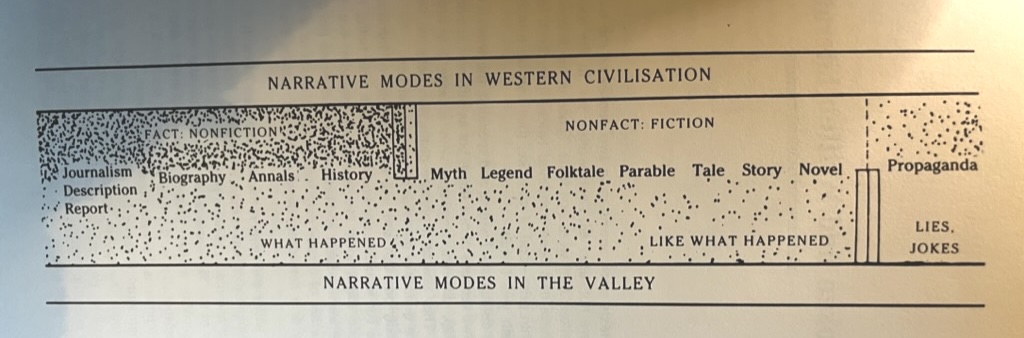
Always Coming Home is a collection of texts from the Kesh, a society in far future Northern California which is also, I guess, a utopian new Bronze Age I suppose? A beautiful book.
This chart is in in the appendix. It reminds me that
- we bucket stories of types like journalism and history as “fact” and types like legend and novels as “fiction,” this binary division
- whereas we could (like the Kesh) accept that no story is clearly fact nor fiction, but instead is somewhere on a continuum.
Myth often has more truth in it than some journalism, right?
There’s a nice empirical typology that breaks down real/not real in this paper about the characters that kids encounter:
To what extent do children believe in real, unreal, natural and supernatural figures relative to each other, and to what extent are features of culture responsible for belief? Are some figures, like Santa Claus or an alien, perceived as more real than figures like Princess Elsa or a unicorn? …
We anticipated that the categories would be endorsed in the following order: ‘Real People’ (a person known to the child, The Wiggles), ‘Cultural Figures’ (Santa Claus, The Easter Bunny, The Tooth Fairy), ‘Ambiguous Figures’ (Dinosaurs, Aliens), ‘Mythical Figures’ (unicorns, ghosts, dragons), and ‘Fictional Figures’ (Spongebob Squarepants, Princess Elsa, Peter Pan).
(The Wiggles are a children’s musical group in Australia.)
btw the researchers found that aliens got bucketed with unicorns/ghosts/dragons, and dinosaurs got bucketed with celebrities (The Wiggles). And adults continue to endorse ghosts more highly than expected, even when unicorns drop away.
Ref.
Kapit’any, R., Nelson, N., Burdett, E. R. R., & Goldstein, T. R. (2020). The child’s pantheon: Children’s hierarchical belief structure in real and non-real figures. PLOS ONE, 15(6), e0234142. https://doi.org/10.1371/journal.pone.0234142
What I find most stimulating about this paper is what it doesn’t touch.
Like, it points at the importance of cultural rituals in the belief in the reality of Santa. But I wonder about the role of motivated reasoning (you only receive gifts if you’re a believer). And the coming of age moment where you realise that everyone has been lying to you.
Or the difference between present-day gods and historic gods.
Or the way facts about real-ness change over time: I am fascinated by the unicorn being real-but-unseen to the Medieval mind and fictional to us.
Or how about the difference between Wyatt Earp (real) and Luke Skywalker (not real) but the former is intensely fictionalised (the western is a genre and public domain, although based on real people) whereas Star Wars is a “cinematic universe” which is like a genre but privately owned and with policed continuity (Star Wars should be a genre).
I struggle to find the words to tease apart these types of real-ness.
Not to mention concepts like the virtual (2021): The virtual is real but not actual
– like, say, power, as in the power of a king to chop off your head.
So I feel like reality is fracturing this century, so much.
Post-truth and truthiness.
The real world, like cyberspace, now a consensual hallucination – meaning that fiction can forge new realities. (Who would have guessed that a post on social media could make Greenland part of the USA? It could happen.)
That we understand the reality that comes from dreams and the subjectivity of reality…
Comedians doing a “bit,” filters on everything, celebrities who may not exist, body doubles, conspiracy theories that turn out to be true, green screen, the natural eye contact setting in FaceTime…
Look, I’m not trained in this. I wish I were, it has all been in the academic discourse forever.
Because we’re not dumb, right? We know that celebs aren’t real in the same sense that our close personal friends are real, and - for a community - ghosts are indeed terrifically true, just as the ghost in Hamlet was a consensus hallucination made real, etc.
But I don’t feel like we have, in the mainstream, words that match our intuitions and give us easy ways to talk about reality in this new reality. And I think we could use them.
This chart from the back of Ursula Le Guin’s Always Coming Home lives forever in my head:
Always Coming Home is a collection of texts from the Kesh, a society in far future Northern California which is also, I guess, a utopian new Bronze Age I suppose? A beautiful book.
This chart is in in the appendix. It reminds me that
Myth often has more truth in it than some journalism, right?
There’s a nice empirical typology that breaks down real/not real in this paper about the characters that kids encounter:
(The Wiggles are a children’s musical group in Australia.)
btw the researchers found that aliens got bucketed with unicorns/ghosts/dragons, and dinosaurs got bucketed with celebrities (The Wiggles). And adults continue to endorse ghosts more highly than expected, even when unicorns drop away.
Ref.
Kapit’any, R., Nelson, N., Burdett, E. R. R., & Goldstein, T. R. (2020). The child’s pantheon: Children’s hierarchical belief structure in real and non-real figures. PLOS ONE, 15(6), e0234142. https://doi.org/10.1371/journal.pone.0234142
What I find most stimulating about this paper is what it doesn’t touch.
Like, it points at the importance of cultural rituals in the belief in the reality of Santa. But I wonder about the role of motivated reasoning (you only receive gifts if you’re a believer). And the coming of age moment where you realise that everyone has been lying to you.
Or the difference between present-day gods and historic gods.
Or the way facts about real-ness change over time: I am fascinated by the unicorn being real-but-unseen to the Medieval mind and fictional to us.
Or how about the difference between Wyatt Earp (real) and Luke Skywalker (not real) but the former is intensely fictionalised (the western is a genre and public domain, although based on real people) whereas Star Wars is a “cinematic universe” which is like a genre but privately owned and with policed continuity (Star Wars should be a genre).
I struggle to find the words to tease apart these types of real-ness.
Not to mention concepts like the virtual (2021): – like, say, power, as in the power of a king to chop off your head.
So I feel like reality is fracturing this century, so much.
Post-truth and truthiness.
The real world, like cyberspace, now a consensual hallucination – meaning that fiction can forge new realities. (Who would have guessed that a post on social media could make Greenland part of the USA? It could happen.)
That we understand the reality that comes from dreams and the subjectivity of reality…
Comedians doing a “bit,” filters on everything, celebrities who may not exist, body doubles, conspiracy theories that turn out to be true, green screen, the natural eye contact setting in FaceTime…
Look, I’m not trained in this. I wish I were, it has all been in the academic discourse forever.
Because we’re not dumb, right? We know that celebs aren’t real in the same sense that our close personal friends are real, and - for a community - ghosts are indeed terrifically true, just as the ghost in Hamlet was a consensus hallucination made real, etc.
But I don’t feel like we have, in the mainstream, words that match our intuitions and give us easy ways to talk about reality in this new reality. And I think we could use them.